 brandinginfotech
If anyone has tried to have a peaceful evening on their terrace or in their garden or at an outdoor gathering in India, they would know how it works—come dusk and the mosquitoes come out. In India, mosquitoes are active in most of the houses for at least half a year, as most of the houses provide them a shelter to breed in, like stagnant drains, potted plants, and open compounds in the monsoon puddles.
Of course the majority of people will turn to the most cost-effective and available option, which is a spray can or a pack of coils. But when you own a backyard, farmhouse lawn, rooftop, or patio at your café, and you are well aware that you have to eradicate the bugs — at least once—you’re in a serious pickle: What works the first time—and the second, and the third?
To see which works and which doesn’t, let’s look at the 3 most popular methods of outdoor mosquito control: sprays, coils, and outdoor mosquito traps.
The Three Options at a Glance
| Method | How it works | Best for | Effective range | Ongoing cost |
| Sprays (aerosol/pump) | Chemical knockdown on contact or short-term repellent barrier | Quick, one-time use before an event | A few square metres, brief duration | Low upfront, adds up with frequent use |
| Mosquito coils | Slow-burning smoke releases pyrethroid insecticide | Small sitting areas, short evenings | 3–6 metres in still air | Low per unit, but needs constant replacement |
| Outdoor mosquito trap | Lures mosquitoes using CO2, heat, or UV, then traps/kills them | Whole-yard, long-term population control | Can cover 200–1000+ sq. metres depending on model | Higher upfront, lower per-day cost over time |
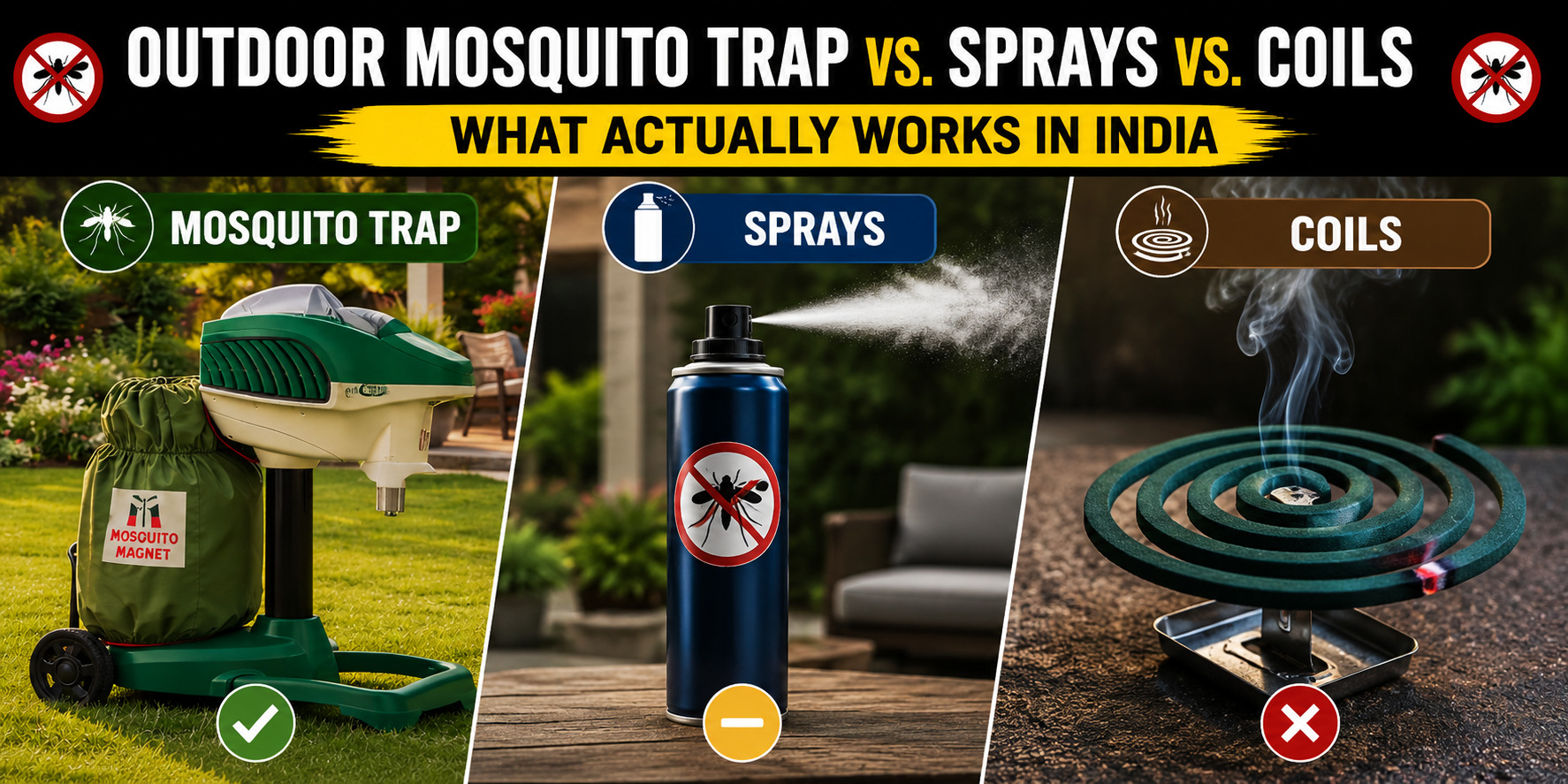
The short version: sprays and coils manage the mosquitoes that are already near you. An outdoor mosquito trap is designed to reduce the overall mosquito population in your outdoor space over days and weeks. These are fundamentally different jobs, and that’s the main reason people get frustrated when they expect a coil to do a trap’s work.
Outdoor Mosquito Sprays: Fast but Fleeting
Unlike sprays and coils, an outdoor mosquito trap is not meant to repel or kill mosquitoes around a person, but to actually lure mosquitoes from a distance and kill them — day and night, whether or not anyone is outside.
How they work: Most traps imitate the signals that mosquitoes use to locate a host, such as carbon dioxide, body heat, moisture, and in some cases, UV light or special scent lures. A mosquito is sucked into, caught or electrocuted by the mosquito’s body, depending on the type, upon being attracted to the light. This means the trap catches mosquitoes all day – not just mosquitoes that happen to be near someone at a certain time.
Pros:
- Instant knockdown for mosquitoes already in the vicinity
- Inexpensive to buy once
- No installation or setup
Cons:
- Wind and open airflow outdoors drastically reduce effectiveness compared to indoor use
- Needs frequent reapplication, which increases chemical exposure for people and pets sitting nearby
- Doesn’t reduce the source population — mosquitoes from surrounding areas simply move back in
- Not practical for larger areas like gardens, lawns, or farmhouses
Sprays are essentially a stopgap. They’re fine for spraying down a small seating corner 15 minutes before guests arrive, but they’re not a strategy for managing mosquitoes across an entire outdoor space over a season.
Mosquito Coils: The Familiar Default
Coils are everywhere in India — cheap, easy to light, and available at every kirana store. But their outdoor performance is more limited than most people assume.
How they work: A coil burns slowly, releasing insecticide-laced smoke into the air around it. The smoke acts as both a repellent and, at close range, a low-grade toxin to mosquitoes.
Pros:
- Very low cost per unit
- No electricity needed, useful for verandas or areas without power points
- Familiar and widely trusted
Cons:
- Effective radius outdoors is small — often just a couple of metres, and even less with any wind
- Smoke inhalation over long periods isn’t ideal, especially for people with asthma, young children, or elderly family members sitting close by
- Needs to be replaced every few hours, so an evening gathering might burn through several coils
- Open flame poses a fire risk around dry leaves, curtains, or wooden furniture — a real concern on terraces and balconies
Coils work reasonably well in a single fixed spot — say, near your feet while sitting on a chair — but they don’t protect a whole patio, and they definitely don’t do anything for the mosquito population breeding in your garden beds or drain pipes.
Outdoor Mosquito Traps: Built for the Bigger Problem
This is where things shift from “manage the moment” to “manage the population.” An outdoor mosquito trap works differently from sprays and coils — instead of repelling or killing mosquitoes near a person, it’s designed to actively attract mosquitoes from a wide radius and eliminate them, day and night, whether or not anyone is outside.
How they work: Most traps mimic the cues mosquitoes use to find a host — carbon dioxide, body heat, moisture, and sometimes UV light or specific scent lures. Once a mosquito is drawn in, it’s captured or killed via suction, sticky boards, or electrocution grids, depending on the model. Because the trap runs continuously, it targets mosquitoes across their whole activity cycle, not just the ones near a person at a given moment.
Pros:
- Covers a much larger area than sprays or coils — some models are rated for several hundred square metres
- Works around the clock, including hours when no one is using the outdoor space
- Reduces the actual breeding and resting population over time, rather than just displacing mosquitoes temporarily
- No smoke, no direct chemical spraying near people, pets, or food — a meaningful advantage for families with kids or anyone sensitive to fumes
- Lower long-term cost per day of protection compared to constantly buying coils or spray refills
Cons:
- Higher upfront investment than a pack of coils or a spray can
- Needs a power source (though several models run on battery or solar for flexible placement)
- Takes some days to weeks to show a noticeable drop in overall mosquito activity, since it’s addressing population levels, not instant knockdown
- Placement matters — traps work best when positioned away from immediate seating areas and closer to likely breeding/resting zones like shaded corners, dense plants, or near standing water sources
If you’re dealing with a farmhouse lawn, a large terrace, a resort or café outdoor seating area, or simply a garden where mosquitoes seem to be a constant year-round issue rather than an occasional nuisance, this is the category built to solve that. Our Outdoor Mosquito Trap Guide goes deeper into how coverage area, lure type, and placement affect performance if you want to compare specific models.
Matching the Method to Your Situation
Not every outdoor space needs the same solution. Here’s a practical breakdown:
A single balcony or small sit-out: A coil or a spray applied right before use is usually enough, given the limited area.
A mid-sized terrace or garden used a few times a week: This is where people often feel let down by coils and sprays — the area is just too large for their limited range. A compact outdoor mosquito trap combined with occasional spray use for guests works better.
A large backyard, farmhouse, or lawn used for parties/events: Sprays and coils alone won’t cut it here — the area is too big and the mosquito source (nearby vegetation, water, drains) is too active. This is the clearest case for investing in a proper outdoor mosquito trap, ideally set up a few days before a planned event so the population has time to drop. Our Backyard Control Guide covers seasonal setup timing for exactly this kind of space.
Ongoing, year-round outdoor mosquito issues: If your outdoor space is a recurring problem — not just a monsoon spike — a trap left running continuously will do far more than repeated coil or spray purchases, both in effectiveness and in total cost over a year.
For a closer look at how these devices actually perform machine-to-machine, our Outdoor Machine Blog compares specific outdoor trap models across coverage, noise, and running cost.
Cost Comparison Over Time
It’s worth actually running the numbers instead of assuming coils and sprays are “cheaper.”
- Coils: At roughly a few rupees per coil and multiple coils needed per evening for a mid-sized area, regular use over a season can easily add up to more than expected, especially if you’re using them almost daily during monsoon and post-monsoon months.
- Sprays: Refill cans aren’t expensive individually, but frequent outdoor reapplication (every 30–40 minutes) means a can empties fast if you’re trying to cover a real gathering.
- Outdoor traps: The upfront cost is higher, but with minimal running cost (mainly power, and occasional lure/cartridge replacement depending on the model), the cost per day of protection drops significantly the longer you use it — especially across a full mosquito season.
If your mosquito problem is occasional, the cheaper short-term options make sense. If it’s a recurring, space-wide issue, the trap pays for itself in a season or two, both financially and in terms of not smelling like a mosquito coil all evening.
Safety Considerations
For households with children, pets, elderly family members, or anyone with respiratory sensitivity, this is often the deciding factor rather than cost:
- Sprays involve direct chemical exposure and shouldn’t be used near food or while people are actively sitting in the treated area.
- Coils produce smoke that isn’t recommended for prolonged close-range exposure, particularly for anyone with asthma or breathing difficulties.
- Outdoor traps don’t release chemicals or smoke into the immediate seating area, since the attraction and kill mechanism happens at the device itself, typically placed away from where people sit.
This is one of the more overlooked reasons families with young kids are increasingly shifting toward traps for outdoor spaces, rather than relying on smoke or spray-based options.
So, What Actually Works?
There’s no single universal answer, but the pattern is clear:
- For a quick, one-off need in a small area — spray or coil, no need to overthink it.
- For a space you use regularly that’s bigger than a small balcony — a trap earns its cost back quickly, both in comfort and in avoiding daily coil/spray use.
- For a persistent outdoor mosquito problem — gardens, lawns, farmhouses, terraces near greenery or water — an outdoor mosquito trap is the only one of the three actually designed to bring the population down rather than just react to it evening after evening.
If you’re ready to look at specific models suited to Indian outdoor conditions — humidity, monsoon intensity, and typical yard sizes — check out our full outdoor mosquito trap range to find one matched to your space.
