 brandinginfotech
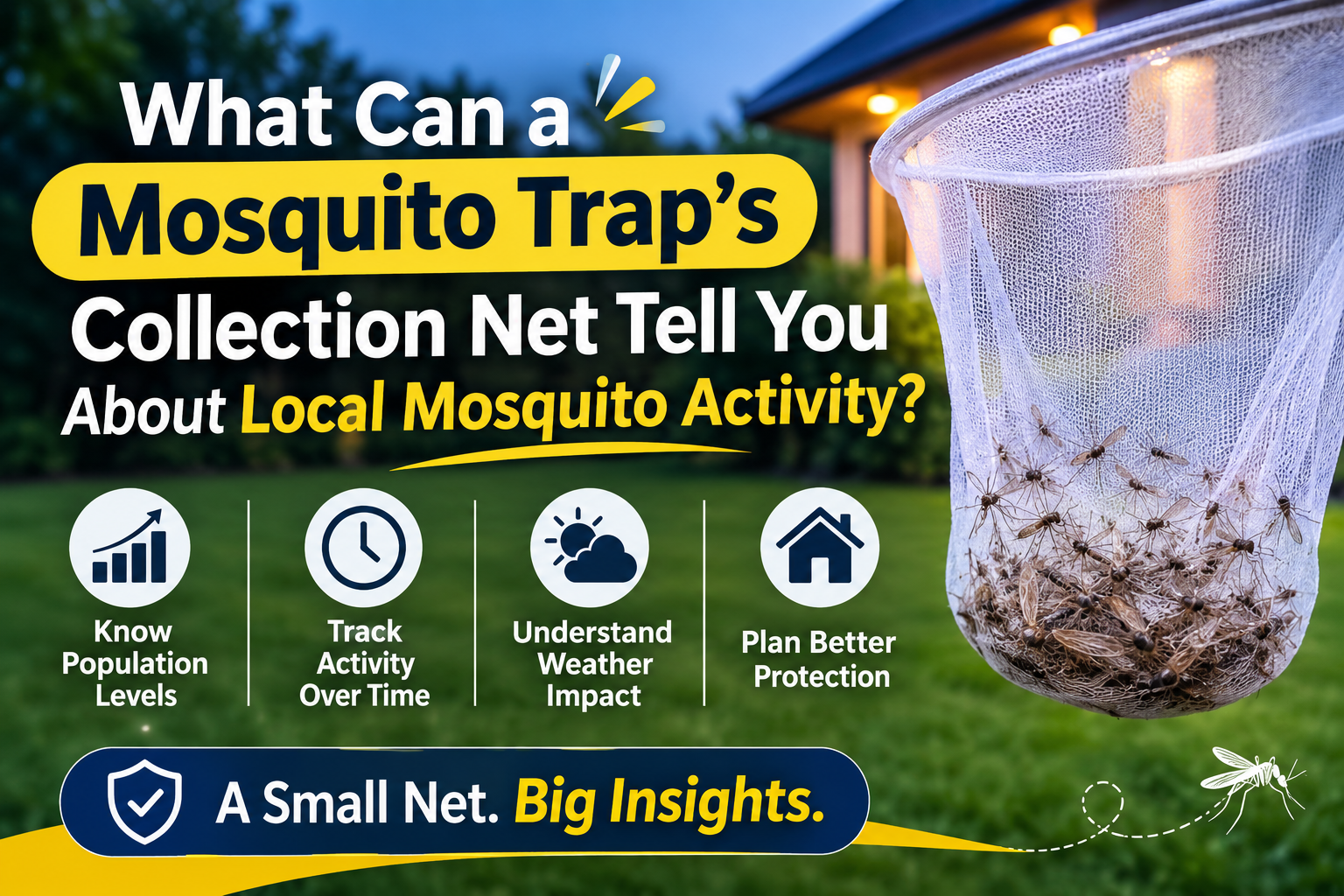
Learn how monitoring the contents of a collection net with mosquito traps transforms the results into actual data regarding species, population trends, and when to act.
It is assumed by most people that the collection net of a mosquito trap is where the mosquitoes go to. Vector control crews have a mousey little look at the immediate situation in your neighborhood regarding mosquito problem.
The contents of that net, the amount that can change as the week goes on, and what species it contains can both tell you when the mosquitoes are “boiling” and what species you are having, and whether your control measures are being effective or not. The basic concept behind mosquito trap monitoring, and one need not wear a lab coat to begin using it.
It is a guide to what the collection net can show, how to read the collection net and how to avoid the most common collection net pitfalls.
1. The Importance of Mosquito Trap Monitoring
The significance of mosquito trap monitoring.
All spraying, larvicide and yard clean-up take time and money. It’s difficult to be sure if they are required or if they are effective, without data.
The measurement from mosquito traps is repeatable and consistent. Public health departments follow the same approach with their mosquito surveillance: they set traps throughout a district, pick them up periodically, and rely upon the numbers of mosquitoes caught to determine when and where to treat. It all scales down to the homeowner, the school, the golf course or the campground.
Instead of saying “Well, it’s like it’s a lot more mosquitoes this week,” you can say “Yes, we caught three times as many as last week; the majority were the species that bites during the day.
2. What Is the Collection Net? What Can the Collection Net Tell You?
How Many Mosquitoes Are There?
The most apparent type of information is the number of mosquitoes trapped in the mosquito trap. The higher the count, the more adult mosquitoes are likely to be present and the lower the count, the fewer adult mosquitoes are likely to be present.
A single number on its own means little, though. If you’re used to 30, 40 may just be a normal night’s sleep. The catch count is only meaningful when compared to previous weeks, the same week last year, and in relation to your baseline.
3. How To Capture A Wolf, A Wolfhound, A Lion, or An Orc. 4. How To Capture An Elfa.
All mosquitoes are not the same and the collection net is used to differentiate them. Species are important because they vary in:
- Biting times: Some bite at night (dusk/dawn) and some bite during the day.
- Breeding sites: flowers pots, gutters are some favorites of small containers, and standing water in marshes, ditches, or retention ponds are some preferred locations.
- Diseases relevance: various diseases are related to various species, such as West Nile Virus or dengue.
When your net fills with small dark mosquitoes with striped legs, you may have container-breeding species nearby, as you’d want to look into buckets, birdbaths and blocked gutters. A catch filled with larger floodwater species following a big rain storm is likely further away, and harder to eradicate yourself.
Identification is a skill you need to develop and a field guide or your local mosquito control district can assist you. It is better to categorize your catch into a couple of general categories than to count everything as “mosquitoes.
The Third Element Is Whether Populations Are Increasing or Decreasing
It is at this point that the usefulness of mosquito population monitoring takes full effect. When you empty and count the net periodically, you start to construct a trend line. The trend can expose:
- A beginning of the season: When the first sustained rise in spring occurs.
- Peaks: Weeks with the greatest activity on which to schedule outdoor activities or treatments.
- Rapid Spikes: Usually after rain, flooding or after a warm spell.
- Declines: A natural decrease, such as when temperatures fall, or a decrease caused by your controls.
An upward trend over 2-3 weeks is an early warning. It’s better to get a head start rather than waiting until the yard becomes intolerable.
4. Mix of Males and Females
Female mosquitoes bite, as they require a blood meal in order to develop eggs. Most of the traps are designed to catch the host seeking females, a predominantly female catch is a good indicator that the trap is catching its target and that biting pressure exists.
May indicate that you are near a emergence site if you are catching unusual numbers of males, as males will remain near the emergence site. You need a magnifier to perform a counting sex, but it’s a helpful extra hint for those who wish to dig deeper.
5. Clues as to Where They Are From
No maps are included with collection nets, but there are clues. Sudden jump a few days after rain indicates any new breeding sites after the rain. If the same catch of container-breeding species is observed, then the water source is likely within a few hundred feet of the trap. Together with a pre-trap walk around your property or neighborhood, trap data helps you concentrate on what to look for rather than what to treat.
3. Does Your Control Efforts Work?
Any type of numbers that incorporate larvicide dunks, source reduction, and professional treatments will all be reflected in these numbers. If the catch decreases in the week or two after you remove the standing water, it means you did the right thing. If the people’s numbers don’t drop, they must still be getting some food.
Removing the mosquito from the trap is not enough, it’s one of the best motivations to use a trap as a measurement instead of a mosquito catcher.
4. What Else Is Flying Around?
Other insects, such as moths, midges and small flies are sometimes caught in the nets. Much of this bycatch is not detrimental to the results, but it does affect how they are read. If the net is filled primarily with nonmosquito insects, the trap may be catching the wrong insects or it may require adjustment. Before counting, be able to tell the difference between mosquitoes and look-alikes such as crane flies and midges.
5. Collecting Reliable Data From Your Trap
If you don’t collect and record regularly, the collection net won’t tell the truth. These are some of the habits that have a big impact:
- Refrain from changing your routine. Empty the net at the same time and at the same interval, such as every morning, or once a week. When mixed intervals are used, it’s not possible to compare counts.
- Use the same location for the trap. If it is moved, it changes what it catches. Select a site that is shaded and sheltered from other attractants such as bright lights, or heavy foot traffic, and leave it alone.
- Write everything down. Write down the date, the number of birds seen, approximate species composition, and weather conditions (rain, temperature and wind). It can be a basic spreadsheet or notebook.
- Save samples for identification. Overnight freezing of the catch will maintain the integrity of the samples for sorting as well as for exchange with area specialists.
- Maintain the trap. If a fan is weak or a battery is weak or if the attractant cartridge is empty, the catch will be reduced and may be interpreted as a decline in populations when there is not.
- If possible, use more than one trap. One trap indicates one spot. Two or three placed around a property will provide a more representative picture.
6. Common Mistakes When Reading a Catch
There are several common mistakes when reading a catch.
- Taking one night at a time. Trap performance is influenced by weather, the phase of the moon, wind and temperature. See how a trend is developing over multiple results, rather than just one.
- Making the assumption that the trap collects all types of things. Traps collect a sub-sample of the population. If there are fewer mosquitoes, this may be due to a low catch, not because there are no mosquitoes.
- Comparing the various types of traps. The lures and species caught by the various traps vary. Compare numbers only with the same type of traps on the same type of catchment.
- Ignoring the environment. Reduction in population during a cold snap or drought is not necessarily a success of your efforts.
- Not checking the species. Just counting the number of mosquitoes can mask significant shifts in the proportion of different types of mosquitoes.
7. When to Take Action Based on Your Catch
There is no standard threshold since “normal” is related to location, time of year and type of trap. The best way to do this is to make your own reference point in a couple of weeks and see if there are any differences:
- Monitor for increased water levels and control breeding areas, and plan outdoor activities accordingly.
- Sudden spike following a rain: If the activity increases, it is likely to be high for some time and consider accordingly.
- An unusual species emerges: Report to the local mosquito control district or health department.
- Effort is not reducing counts: Consider community level control and breeding sources outside of your property.
For public monitoring, or if you are worried about the risk of disease, please call your local vector control or public health authority. They are able to make identification, test samples for pathogens and provide contextualization of your data in a broader landscape.
8. The Bottom Line
The collection net of a mosquito trap is not just a bag of mosquitoes. Read carefully and consistently, it will show you the number of mosquitoes active, species present, if the population is increasing and if control is being effective.
It is best to keep it simple; choose a place, set a date, count and record it. After just a few weeks, you will know what is going on with the mosquitoes around you and be able to make decisions accordingly rather than “guesstimating.”
Let’s begin tracking! Make your trap, count this week and let the data tell you what’s really happening in your backyard.
