 brandinginfotech
Picture this: it’s a warm evening, you finally sit down outside after a long day, and for a few minutes, everything’s peaceful. Then you feel that first bite on your arm. You swat it away, settle back in, and a few minutes later — there’s another one.
You glance around. There’s no puddle of stagnant water in sight. The yard looks clean. So why do the mosquitoes keep finding you?
Here’s the thing: they’re not just stumbling onto you by chance. They’re tracking you.
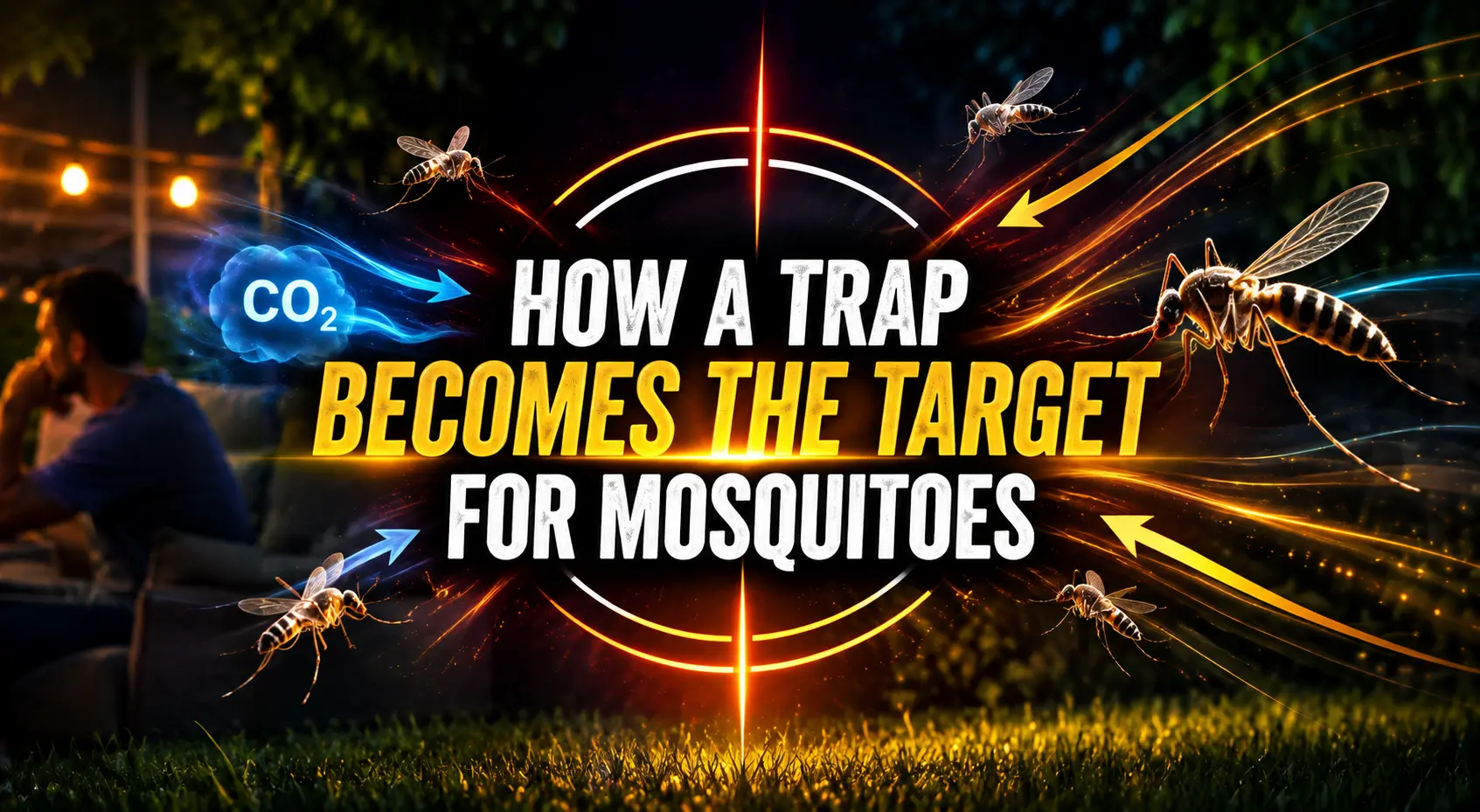
Every time you sit outside, your body is broadcasting signals a mosquito can pick up on. You exhale carbon dioxide with every breath. Your skin gives off heat and moisture. Chemical compounds drift off your body. Even your movement and silhouette give something away. Put it all together, and to a mosquito on the hunt, you’re basically lit up on a map.
That’s really the starting point for understanding how mosquito traps work. A good outdoor trap isn’t just a bug zapper with a fancy name — it’s a device built to hijack the mosquito’s own host-seeking instincts, luring it toward a fake “host” instead of you.
CO₂ attraction sits at the center of most of this technology, since carbon dioxide is one of the main long-range cues mosquitoes rely on to find something to bite. Once you understand that, terms like outdoor mosquito trap, CO₂ mosquito trap, mosquito magnet, and mosquito trap machine start to make a lot more sense—they’re all pointing at the same basic idea: pull mosquitoes away from people and capture them instead.
It Starts With How Mosquitoes Actually Find You
A mosquito doesn’t spot you from across the yard and beeline in your direction. The process is a bit more layered than that.
When you breathe, the CO₂ you exhale drifts out into the air and forms a plume that gets pushed around by whatever breeze is moving through your yard. Mosquitoes are wired to notice shifts in CO₂ concentration, and they treat those shifts as a strong hint that a living, breathing target is somewhere nearby.
As they close the distance, other cues start to take over. Your body heat becomes a signal they can home in on. The moisture around your skin adds another layer. And once they’re close enough, the chemical makeup of your skin and breath helps them make that final approach and land.
So really, host-seeking behavior plays out in stages:
- Pick up a long-range signal (usually CO₂).
- Follow it.
- Start layering in closer-range cues like heat and moisture.
- Land on whatever seems like a suitable host.
A well-built mosquito trap leans into this entire sequence rather than just hoping a mosquito happens to fly past it. The goal isn’t to passively wait — it’s to insert itself directly into the mosquito’s navigation process, as if it were another potential host.
So What Exactly Is a Mosquito Trap
At its core, a mosquito trap is a system built to attract, intercept, and capture mosquitoes. Different traps go about the “attract” part differently — some lean almost entirely on CO₂, while others blend it with heat, moisture, light, or other lures. A fan usually does the heavy lifting of pulling the mosquito the rest of the way in.
You can break the whole process down into four basic stages: attract, guide, capture, retain. First the trap has to get a mosquito’s attention. Then it needs to draw that mosquito toward the capture zone. Then it physically pulls the insect in. And finally, it has to keep it there.
Which is why “trap” is a slightly misleading word for what’s actually going on. The hard engineering problem isn’t catching mosquitoes — it’s building an attraction system convincing enough that mosquitoes choose to follow it in the first place.
Why Carbon Dioxide Is Such a Big Deal in Trap Design
CO₂ is arguably the single most important signal in the whole host-seeking process. You’re constantly exhaling it, and outdoors, that CO₂ doesn’t just hang in one spot — it becomes part of a shifting plume, pushed and pulled by wind and turbulence.
Mosquitoes can detect those shifts. But here’s the interesting part: it’s not just about volume. How the plume behaves matters just as much as how much CO₂ is in it.
Human breathing doesn’t release CO₂ in one steady stream — it comes out in pulses, tied to each breath. So a trap that’s trying to mimic a real host has to think beyond just “release some CO₂ into the air.” It also has to account for how that plume moves, how the surrounding airflow shapes it, and how it disperses over distance.
That’s essentially why CO₂ traps are designed around the idea of simulating a host rather than simply pumping out gas. Instead of leaving mosquitoes to stumble onto the device by luck, the system tries to recreate the same kind of signal a mosquito would naturally use to find a living creature.
How a CO₂ Trap Fakes Out a Mosquito
There’s more than one way to get carbon dioxide into a mosquito trap.
One common method is combustion — burning fuel to generate CO₂. What makes this approach appealing is that combustion doesn’t just produce carbon dioxide; it also generates heat and moisture as a byproduct. And that matters, because a living animal never gives off just CO₂ on its own — warmth and moisture come along with it. A trap that can offer all three at once is putting together a far more convincing “host” than one relying on CO₂ alone.
Other systems draw CO₂ from stored tanks or generate it through biological processes instead.
Whatever the source, the underlying idea stays the same: a mosquito picks up the signal, tracks the plume back to its source, and eventually ends up in the capture zone. The real engineering challenge is making that whole sequence reliable enough to work outdoors, where conditions are constantly changing.
Why “Mosquito Magnet” Isn’t Just Marketing Talk
The logic behind a mosquito magnet is pretty straightforward once you break it down. If mosquitoes are actively hunting for a host, then building something that mimics a host well enough can actually redirect where they fly.
Think about a mosquito picking up a CO₂ plume somewhere in your garden. It detects the signal from a distance and starts moving toward it. As it gets closer, it expects to pick up on more cues — heat, moisture, and so on. If the device delivers enough of those secondary signals, the mosquito keeps coming. Eventually it reaches the capture zone, where a fan or suction system pulls it in and separates it from the outdoor environment for good.
There’s nothing literally magnetic happening here, obviously. “Magnet” is just a convenient way to describe a device that convincingly mimics a host and uses that illusion to reroute mosquito traffic. The actual mechanics come down to mosquito sensory biology, airflow dynamics, and mechanical capture — nothing more mysterious than that.
Outdoor Traps Face a Different Set of Problems Than Indoor Ones
Indoors, airflow is fairly predictable — four walls keep things contained. Outdoors is a completely different story. Wind constantly moves the attractant plume around, then just as easily disrupts it. Trees, fences, and shrubs all reshape how air flows through a yard. Temperature and humidity shift throughout the day too.
All of which means an outdoor trap has to hold up in a constantly changing environment — and that puts a lot of weight on where you actually put the thing. Even a powerful trap can underperform badly if it’s sitting in the wrong spot. Ideally, its plume should drift through the areas mosquitoes are naturally moving through, while staying far enough from people that your own CO₂ isn’t competing with the machine’s.
So outdoor mosquito trapping isn’t purely an engineering question. Just as much of it comes down to placement.
Where Should You Actually Put One?
Don’t just plug it in near the nearest outlet and call it a day. Think about how air actually moves through your outdoor space, and consider the trap’s position relative to:
- Where people usually sit
- Seating areas and patios
- Vegetation and shaded spots
- Any potential breeding sites
- Wind direction
- Walls and fences
- Other sources of heat or CO₂ nearby
Ideally, you want the trap set back from where people actually hang out, so it works as an interception point instead of going head-to-head with your own CO₂ output. Shaded, planted areas tend to see more mosquito activity too, so if you notice mosquitoes seem to be coming from a particular direction, that’s worth factoring into placement.
Wind especially deserves attention, since it’s what carries the CO₂ plume in the first place. A gentle, steady breeze usually creates a clean, followable trail. Gusty, turbulent conditions tend to scatter the plume and make it harder for mosquitoes to track.
The takeaway here is simple: where you put the trap is part of the trap. You can’t really separate the machine from its surroundings.
What Happens Once a Mosquito Actually Reaches the Trap
Getting a mosquito’s attention is only half the job — the capture side has to finish what attraction started.
Most traps rely on an intake zone paired with a fan. Once a mosquito enters that zone, airflow pulls it into a collection chamber, cutting it off from the outside air for good.
This part of the design matters more than people tend to assume. A trap can have a brilliant attraction system and still underperform if the capture mechanism is weak. On the flip side, a powerful fan won’t do much if mosquitoes aren’t being drawn close enough to reach it in the first place. Attraction and capture have to work in sync — neither one is enough on its own.
CO₂ Isn’t the Whole Story
CO₂ gets a lot of the credit, but mosquitoes are using more than one sense at a time. At longer range, carbon dioxide does most of the directional work. Closer in, heat and moisture take over. And right before landing, chemical and visual cues fill in the rest of the picture.
That’s why a lot of modern traps stack multiple attraction methods instead of leaning on just one. You can basically think of it as a mosquito gradually building a fuller picture of its “host”:
CO₂ → heat → moisture → close-range cues → capture
Not every trap uses all of these, and how much any single cue matters can shift depending on the mosquito species and the conditions outside. But this general sequence is a useful way to think about how trapping works.
Traps Alone Won’t Solve a Mosquito Problem
Here’s something easy to overlook: adult mosquitoes are just one stage of the life cycle. Most species need standing water to breed, which means catching adults is only part of the picture.
Old containers, plant saucers, clogged gutters, discarded tires — anything holding stagnant water is a potential breeding ground, and it’s worth checking for regularly. A trap deals with the mosquitoes that are already flying around looking for a host. It does nothing to stop new ones from hatching.
If you’re running a trap but ignoring an obvious breeding site a few feet away, you’re fighting an uphill battle. The smarter approach treats the mosquito population as a cycle — not a collection of individual bugs you’re picking off one at a time.
Traps vs. Repellents: Two Different Strategies
Repellents and traps tackle the problem from opposite directions. A repellent tries to make you less detectable or less appealing to a mosquito. A trap, on the other hand, creates a competing target altogether.
Picture a group of people sitting around a backyard fire pit. Collectively, they’re giving off plenty of CO₂, heat, and moisture. Now place a trap some distance away, generating its own version of those same signals. Instead of relying purely on making the people invisible to mosquitoes, the trap tries to intercept mosquitoes before they ever reach the group.
That doesn’t mean the people become completely mosquito-proof — species, placement, wind, and how strong the competing signals are will all affect the outcome. But it does highlight why trapping and repelling are fundamentally different strategies, not just two versions of the same idea.
Don’t Expect Overnight Results
One of the biggest misconceptions people have about mosquito traps is expecting them to wipe out the local population in a single evening. That’s just not how they work.
Mosquito populations are constantly shifting — new adults emerge, insects move in and out of an area, and breeding sites keep producing more of them. A trap makes its impact through repeated, ongoing exposure. Over time, as mosquitoes get consistently intercepted, the local population can genuinely start to decline.
Which means consistency matters a lot. A trap that only runs occasionally is going to have a very different impact than one running continuously during peak mosquito hours. Rather than asking “did it catch a ton tonight,” a better question is: is it steadily intercepting host-seeking mosquitoes night after night?
Weather Changes Everything
No trap operates in a controlled lab environment — it’s out there dealing with real weather. Wind speed and direction reshape the CO₂ plume. Temperature affects how active mosquitoes even are. Humidity shifts the whole outdoor environment. Vegetation growth changes airflow patterns. Rain can trigger new mosquito activity and even create fresh breeding spots. Even moving a patio chair can subtly change airflow around the trap.
So if mosquito activity seems to fluctuate week to week, that doesn’t necessarily mean the trap has stopped working. More often than not, it’s the environment around it that’s changed.
Keeping a Trap Working Properly
Like any piece of equipment, a trap needs upkeep. The collection chamber should be checked and cleaned regularly. Keep the intake clear of debris, and don’t let the collection area get clogged. Whatever fuel, CO₂ source, or consumable component your specific trap uses should be maintained per its instructions.
It’s also worth reassessing placement every so often. Plants grow. Furniture gets rearranged. Seasonal wind patterns shift. A spot that made perfect sense in spring might be sitting in completely different airflow by late summer. Maintenance isn’t just about a clean machine — it’s about preserving the conditions the trap was designed to work in.
Sorting Out the Terminology
The language around mosquito trapping can make it sound more complicated than it really is.
Outdoor mosquito trap just describes where and how it’s used. CO₂ mosquito trap emphasizes the attraction method. Mosquito magnet describes the concept of building an artificial host signal that redirects mosquito movement. Mosquito trap machine is a broader, more general term for the hardware itself.
These terms overlap constantly because they’re all describing different facets of the same basic approach. What actually matters isn’t what you call the device — it’s how it attracts mosquitoes, how it guides them, how it captures them, where it’s placed, how consistently it runs, and how it fits into your broader mosquito-control plan.
Zooming Out: Mosquito Control as a System
Mosquito problems are rarely caused by just one thing. Maybe there’s shaded vegetation nearby. Maybe a neighboring property has standing water. Wind might be blowing mosquitoes onto your property from somewhere else entirely. People might be spending hours outside in the evening, right when certain species are most active.
Because of all that, a solid mosquito-management plan has to look at the whole picture, not just one piece of it. A trap handles the adults that are actively searching for a host. Source reduction deals with breeding. Managing vegetation and habitat cuts down on favorable conditions in general. Other measures might be worth adding depending on your specific situation.
No single tool is going to knock out every stage of the mosquito life cycle by itself — and that’s fine. It’s not supposed to.
The Simple Machine With Real Science Behind It
At a glance, a Mosquito trap looks pretty basic: a housing, a fan, a collection chamber, some kind of attractant. But under that simple shell is a genuine mix of biology and engineering.
Mosquitoes have evolved a remarkably sensitive toolkit for finding hosts — detecting CO₂, sensing heat, picking up on moisture, responding to chemical cues, and reading the airflow around them as they search. A trap works by turning those same instincts against the mosquito itself. The better it recreates the relevant signals and channels them into a controlled capture zone, the more effective it becomes.
That’s really the whole idea behind modern mosquito trapping, stripped down to its essentials.
Bottom Line
The story of an outdoor mosquito trap really starts with the mosquito. When it’s hunting for a blood meal, it’s not flying around at random — it’s reading signals carried through the air. Carbon dioxide gives it the first long-range clue. Heat and moisture take over as it gets closer. Chemical and visual cues finish the job right before it lands.
A CO₂ trap simply uses that same behavior against the mosquito, offering up a convincing alternative target. The “mosquito magnet” idea isn’t complicated once you see it this way — it’s about mimicking a host closely enough to pull mosquitoes toward a controlled capture point instead of toward you.
But attraction alone won’t get the job done. Placement matters. Airflow matters. Regular maintenance matters. So does the weather, whether you like it or not. And trapping adults should really go hand in hand with cutting down on breeding sites, not replace that effort entirely.
At the end of the day, dealing with mosquitoes outdoors isn’t about finding one miracle device. It’s about understanding how mosquitoes live, move, breed, and hunt — and once you get that, tools like CO₂ traps and mosquito magnets stop feeling like mysterious gadgets and start making a lot of sense.
