 brandinginfotech
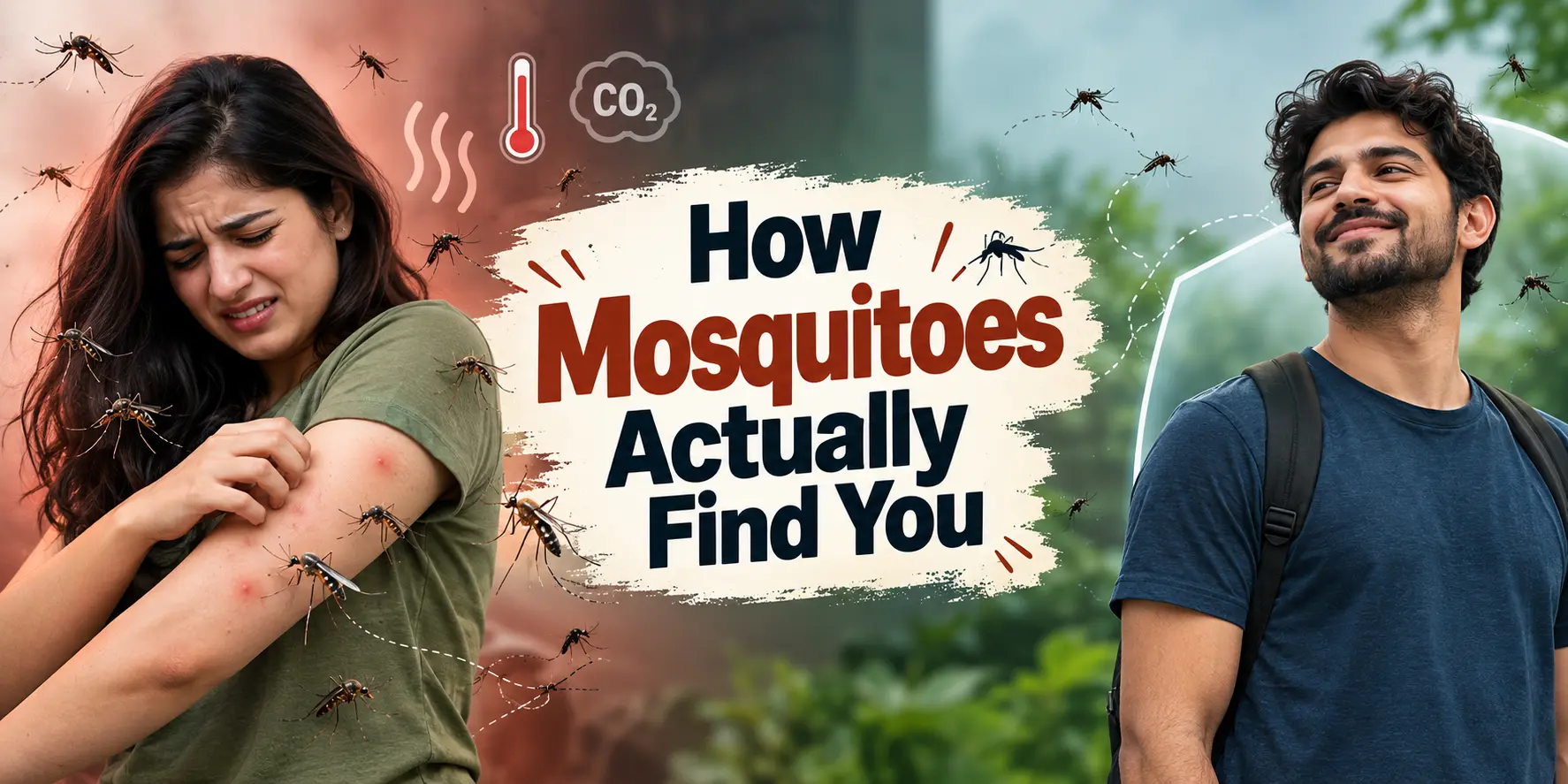
If you’ve ever sat next to someone at a barbecue and watched them get bitten fifteen times while you escape without a single itch, you already know mosquitoes aren’t just bumbling around at random. They’re working with a surprisingly refined set of tools — carbon dioxide detection, heat sensing, smell, moisture tracking, and even vision — all stacked together to zero in on a host.
That’s also why you’ll swear the mosquitoes get “worse” at dusk. It’s not your imagination. Their hunting behavior shifts with the time of day, the temperature, the humidity, and even which species you’re dealing with.
Here’s a closer look at how they pull it off, why some hours are worse than others, and what that means for actually keeping them off you.
What Makes Mosquitoes Zero In on Certain People
There isn’t one single “mosquito bait.” It’s a layered process, and different cues matter at different distances.
Carbon dioxide gets their attention first
Every time you exhale, you’re sending out a plume of CO₂, and mosquitoes are remarkably good at picking up on shifts in carbon dioxide levels in the air around them. This is usually the first clue that tells a mosquito “something’s breathing nearby” — it’s how they start narrowing down a search area from farther away. Once they’ve closed the distance, other signals take over.
Your skin has a smell they can track
Sweat and everyday skin chemistry produce a distinct scent profile for each person, and mosquitoes respond to some of those chemical signatures more than others. This is a big part of why mosquitoes seem to have “favorites” at a gathering. The mix of bacteria living on your skin, along with your individual sweat chemistry, shapes an odor that some mosquitoes find more appealing than others.
Body heat as a homing signal
Once a mosquito is in range, warmth becomes a useful marker. Since we run warmer than the surrounding air — especially once the sun goes down — mosquitoes can pick up on that heat differential and use it to pinpoint exactly where a host is.
Sweat and moisture do more than just feel wet
It’s not the wetness itself that draws mosquitoes in. Sweat changes the chemistry right at the skin’s surface and releases compounds mosquitoes can detect. The humidity that builds up around your body can also help guide them in, especially when it’s paired with the other signals already mentioned.
They’re watching you, too
Mosquitoes do use vision, and dark or high-contrast shapes tend to stand out to them more easily — particularly once they’re already on the hunt. That said, sight is really just one piece of the puzzle. A mosquito isn’t spotting you from across the yard and beelining toward you; vision mostly helps fine-tune the approach once other cues are already in play.
Putting It All Together: The Hunt in Sequence
Think of it as a funnel. A mosquito picks up on carbon dioxide first, which tips it off that a potential meal might be somewhere nearby. From there, it adjusts its flight path as CO₂ concentrations shift, following the trail like a scent.
As it gets closer, body odor, heat, moisture, and visual contrast all start factoring in more heavily.
By the time it actually lands, the mosquito is using sensory receptors on its body to check the skin before it commits to biting.
This layered system — long-range cues followed by short-range ones — is exactly why mosquitoes can track people down even in low light or thick vegetation where you’d think they’d struggle.
Why Evenings Feel Like Prime Mosquito Hour
It’s a common complaint: the bites really pick up once the sun starts going down. But it’s worth noting up front that this isn’t universal — plenty of mosquito species are actually daytime biters, not night owls.
Still, for the species that are more active after dark, a few things are working in their favor.
Cooler temperatures. Many mosquitoes do better in the milder air that shows up in the evening compared to the heat of midday.
Rising humidity. Mosquitoes lose moisture easily, so the added humidity after sunset tends to work in their favor for both survival and general activity.
Less harsh sunlight. Intense sun and daytime heat can actually push some species to lay low. Once that pressure eases off in the evening, they become noticeably more active.
Built-in rhythms. On top of environmental factors, each species has its own internal clock dictating when it prefers to search for a host.
So while “mosquitoes come out at night” is a decent rule of thumb, it’s not the whole story — it really comes down to which species you’re dealing with and what the local conditions look like.
How Far Do They Actually Fly?
Contrary to what it might feel like when they show up out of nowhere, mosquitoes aren’t covering long distances the way migratory birds or other insects do. Their range is shaped mostly by where they can find food, breeding water, shelter, and vegetation — plus a boost or hindrance from the wind.
Some species barely stray from wherever they hatched and rest. Others will travel considerably farther, especially if the wind is helping push them along.
This is exactly why clearing mosquitoes out of one small patch of yard doesn’t always fix the problem for good. If there’s a breeding site or resting spot nearby, new mosquitoes will just keep drifting back in.
In other words, the bigger picture around your immediate space matters just as much as what’s happening right where you’re standing.
The Mosquito Life Cycle, Briefly
How long a mosquito sticks around depends on its species, plus temperature, humidity, and how easy it is to find food.
Every mosquito goes through the same four stages: egg, larva, pupa, adult.
The first three all happen in water. Once a mosquito reaches adulthood, it spends its time feeding, resting, mating, and — for females — laying eggs.
Lifespan varies quite a bit depending on species and sex. Males generally don’t live as long and stick to feeding on nectar and other plant sugars. Females, on the other hand, typically need a blood meal to get the nutrients required to develop eggs — which is the whole reason they’re after you in the first place.
Environmental conditions can speed up or slow down how fast mosquitoes develop, and how long the adults survive once they get there.
Why Breeding Sites Deserve Just as Much Attention as Bites
Once you understand how mosquitoes operate, it makes a lot more sense why so much prevention advice comes back to standing water.
Most mosquitoes lay eggs in or near water that isn’t moving — buckets, plant saucers, clogged gutters, old tires, storage containers, anything that can collect and hold water for a while.
Even a small, easy-to-miss puddle can be enough for mosquitoes to develop in, given the right conditions.
That’s the real reason mosquito control can’t just focus on swatting adults. Cutting off the breeding sites is what actually stops the next wave from showing up.
So What Actually Helps?
Because mosquitoes are relying on so many overlapping signals to find you, there’s no single trick that solves everything. A combination usually works best:
- Dump out or regularly refresh any standing water around your home.
- Keep gutters and drains clear so water doesn’t sit and stagnate.
- Use screens on windows and doors where you can.
- Cover more skin with clothing when mosquitoes are especially active.
- Reach for a repellent when conditions call for it.
- Don’t let water pool unnecessarily in outdoor spaces.
- Keep an eye on shaded, damp, overgrown areas — mosquitoes love them.
- Match your control approach to your actual environment rather than a one-size-fits-all fix.
Really, the most effective strategy comes down to knowing three things: where mosquitoes are breeding nearby, when the local species tend to be active, and what conditions are drawing them toward you specifically.
The Bottom Line
Mosquitoes are genuinely good at what they do. Carbon dioxide, body odor, heat, moisture, and vision all work together to help them track down a host, and their activity shifts based on species, weather, and time of day.
Evenings tend to be the worst for many people, but plenty of species are just as happy biting in broad daylight. And how far mosquitoes travel to find you depends heavily on the species and what’s happening in the environment around them.
Once you understand the full picture — breeding grounds, activity patterns, environmental triggers, and how to limit contact with adults — mosquito prevention stops feeling like guesswork and starts feeling a lot more manageable.
