 brandinginfotech
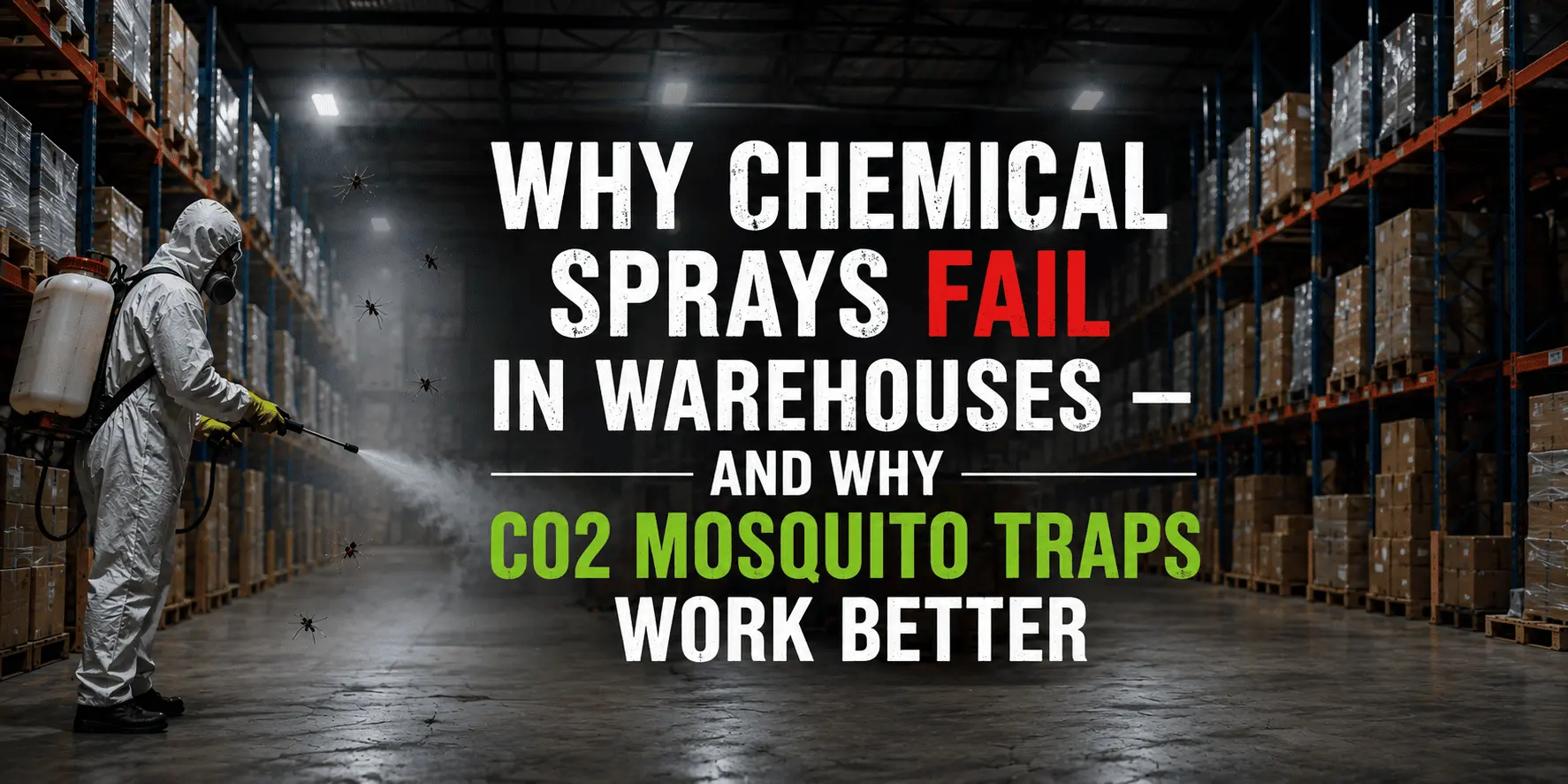
Mosquito control in warehouses is a different problem from mosquito control in homes, offices, or small retail spaces. Large floor areas, high ceilings, constant movement of goods, loading bays, drains, dark corners, and inconsistent airflow all create the kind of environment where mosquitoes can survive despite regular treatment. Many facility managers respond with chemical sprays because they seem fast and familiar. But in warehouse settings, sprays often deliver only short-term relief while the root problem remains active.
A CO2 mosquito trap offers a more effective and practical approach for many warehouse environments. Instead of relying on broad chemical exposure, it uses mosquito behavior against them. To understand why that matters, it helps to look at why chemical sprays underperform in industrial spaces and how the science behind CO2 trapping makes it a smarter long-term solution.
Why warehouses are difficult environments for mosquito control
Warehouses create ideal hiding and resting zones for mosquitoes. Even if the building looks clean and organized, there are usually multiple conditions that support mosquito activity:
- Large open interiors make it difficult for sprayed chemicals to reach every mosquito resting spot.
- High racks and shelving systems create protected areas where spray droplets may never land effectively.
- Loading docks and open entry points allow mosquitoes to keep entering from outside.
- Drainage areas, pallets, packaging waste, and moisture pockets can support breeding or resting behavior.
- Round-the-clock operations make it hard to schedule aggressive chemical treatment safely and consistently.
In smaller spaces, a spray may contact a higher percentage of the mosquito population. In a warehouse, that same strategy often fails because the environment is too large, too complex, and too dynamic. What looks like treatment success on day one can quickly turn into another infestation cycle a few days later.
The main reason chemical sprays fail in warehouses
The biggest weakness of chemical sprays is that they depend on direct contact or close exposure. If the mosquito is hidden behind inventory, resting under pallets, inside dark utility corners, or entering after treatment has been completed, the spray does not solve the actual problem.
Here is where most spray-based warehouse mosquito control breaks down:
1. Sprays rarely reach every mosquito
Mosquitoes do not stay exposed in the middle of the floor waiting to be treated. They rest in shaded, humid, low-disturbance areas. In a warehouse, these areas are everywhere – behind cartons, near sump pits, around wash zones, beside dock seals, and along structural edges.
Even when a chemical is applied correctly, coverage is rarely complete. Missed pockets allow the population to recover quickly.
2. Sprays provide short-term knockdown, not long-term control
A spray may kill some active adult mosquitoes immediately, which creates the impression that the issue has been solved. But eggs, larvae, newly entering mosquitoes, and hidden adults are often untouched. As a result, the relief is temporary.
This is why many warehouses end up in a repetitive cycle:
- Mosquitoes become visible.
- Spray is applied.
- Activity drops briefly.
- Mosquitoes return.
- The same treatment is repeated.
That cycle increases cost without delivering stable control.
3. Airflow and space reduce spray efficiency
Warehouses are not sealed environments. Fans, vents, dock openings, vehicle movement, and changing air pressure patterns interfere with how spray particles disperse and settle. In large-volume spaces, the concentration needed for reliable impact is hard to maintain.
What works in a small room simply does not scale well to a large logistics facility.
4. Chemical dependence creates operational concerns
Frequent spraying inside a warehouse can create additional challenges:
- Worker exposure concerns, especially in facilities with long shifts
- Odor complaints in occupied spaces
- Potential contamination worries near packaging or stored goods
- Downtime or restricted-access windows during treatment
- Repeated application costs that add up over time
Even when approved chemicals are used properly, constant reliance on sprays is rarely the most elegant solution for a busy industrial site.
5. Mosquitoes return from outside sources
Most warehouses are connected to the outdoors through truck bays, side entrances, utility gaps, and surrounding drainage areas. That means new mosquitoes can enter every day. Chemical sprays inside the building do little to stop incoming host-seeking females from finding workers and resting zones.
In other words, spray treatment is often reactive, while the mosquito pressure is continuous.
The CO2 trap advantage in warehouse mosquito control
A CO2 mosquito trap works differently. Instead of trying to blanket the warehouse with chemicals, it attracts mosquitoes actively searching for a blood meal. Female mosquitoes locate hosts by following several signals, and one of the strongest is carbon dioxide. Humans exhale CO2 continuously, and mosquitoes have evolved to detect it from a distance.
That is the core of the science behind CO2 trapping: the trap imitates a living host.
Once mosquitoes are drawn toward the source, the trap uses suction, airflow, or capture mechanisms to remove them from the environment. Rather than hoping mosquitoes happen to contact a sprayed surface, the trap persuades them to move toward it.
This matters because attraction-based control fits warehouse reality much better than surface-dependent chemical treatment.
Science behind CO2 trapping
Mosquitoes do not randomly bite people. They locate hosts through a sequence of cues, including:
- Carbon dioxide
- Body heat
- Skin odors and volatile compounds
- Movement and contrast
CO2 is especially important because it acts as a long-range activator. When a mosquito senses a CO2 plume, it begins moving in that direction and becomes more responsive to other host cues. A well-designed CO2 mosquito trap taps into that natural behavior by creating an artificial host signal that competes with human presence.
In a warehouse, this has a major practical advantage. Instead of treating walls, racks, and airspace indiscriminately, the system focuses on mosquito behavior. It intercepts females that are actively looking to feed – the same mosquitoes most likely to bite staff and sustain the nuisance problem.
That behavioral targeting is one reason CO2-based systems are increasingly attractive for commercial and industrial mosquito management.
Why CO2 mosquito traps perform better in warehouses
Continuous control instead of occasional treatment
Chemical sprays are typically event-based. A CO2 trap works continuously. That means mosquitoes are being attracted and captured day after day, including between inspections and treatment visits.
For warehouses with constant mosquito pressure, continuous control is far more valuable than periodic knockdown.
Better fit for large and complex layouts
A warehouse has too many hiding places for perfect spray coverage. But mosquitoes still need to search for hosts. A properly positioned CO2 mosquito trap can exploit that movement pattern. Rather than reaching into every hidden corner, the trap draws mosquitoes out.
This is a major operational advantage in facilities with tall storage systems, segmented zones, and frequent stock movement.
Reduced chemical load
One of the clearest commercial benefits is lower dependence on RF science-repeated spray programs. Facilities looking for a more sustainable and staff-friendly approach often prefer solutions that reduce routine chemical exposure while maintaining control performance.
For many sites, CO2 trapping becomes either the primary method or the backbone of an integrated mosquito management plan.
Better protection near people
Mosquitoes in warehouses are not just a nuisance. They affect worker comfort, concentration, and perceived hygiene standards. In some sectors, they can also raise audit or compliance concerns. Because CO2 traps target host-seeking mosquitoes, they help protect active work areas more directly than treatments aimed only at surfaces.
Ongoing data and visibility
Many commercial trapping systems also support monitoring. Capture counts can help identify pressure zones, seasonal spikes, or areas near entry points and drainage that need attention. That makes mosquito control more measurable and strategic, rather than purely reactive.
When chemical sprays still have a role
This does not mean sprays have no place at all. In some cases, targeted chemical treatment may still be useful for rapid response or hotspot suppression. But in warehouses, sprays work best as a supporting tool, not the entire strategy.
A stronger model is:
- Identify breeding and entry sources.
- Improve sanitation and drainage where possible.
- Deploy a CO2 mosquito trap in high-risk zones.
- Use limited, targeted chemical treatment only when necessary.
That approach is usually more stable, more cost-effective over time, and easier to manage operationally than repeat full-area spraying.
Choosing the right solution for warehouse mosquito control
If a warehouse is experiencing recurring mosquito activity despite repeated chemical treatment, the problem is often not product failure alone – it is strategy failure. The environment is simply not well suited to spray-only control.
A CO2 mosquito trap addresses the weakness of chemical sprays by targeting the way mosquitoes actually find people. That is the real CO2 trap advantage. It turns mosquito biology into the control mechanism, supports continuous capture, reduces dependence on repeated spraying, and fits better within the practical realities of industrial facilities.
For businesses evaluating warehouse mosquito control options, the key question is no longer just how to kill visible mosquitoes today. It is how to reduce mosquito pressure consistently, safely, and efficiently over time. In many warehouse environments, CO2-based trapping is the answer because it is built around behavior, not just chemical exposure.
When mosquito pressure is persistent, smarter attraction-based control usually outperforms short-lived chemical knockdown. And in a warehouse, that difference can mean fewer complaints, better working conditions, and a much more reliable pest management strategy.
