 brandinginfotech
I don’t know a single person who enjoys sitting outside in the evening and constantly slapping their arms and legs. You light a coil, it burns for twenty minutes, the wind shifts, and suddenly you’re back to square one. If this sounds familiar, you’ve probably already looked into buying a mosquito killer machine for outdoor use—and honestly, it’s one of the smarter decisions you can make for your home.
This isn’t going to be one of those generic “top tips” articles. Let’s actually get into how these machines work, why they beat the sprays and coils most of us grew up using, and what to check before you spend your money on one.
Why Outdoor Spaces Are Harder to Protect
Here’s the thing about mosquito repellents—most of them were designed for closed rooms. A plug-in vaporizer or a coil works fine in a bedroom because the smoke has nowhere to go. It just sits there in the air until it does its job.
Take that same coil outside, though, and it’s a different story. Wind carries the smoke away within minutes. Open space means there’s no “concentration” building up around you. So people end up lighting three or four coils at once, which honestly still doesn’t help much, and now you’re breathing in a lot more smoke than you probably should.
This is exactly the gap that outdoor mosquito killer machines are built to fill. Instead of depending on smoke or scent hanging in still air, they actively pull mosquitoes toward the device itself—regardless of how much space is around it.
So How Do These Machines Actually Work?
There isn’t just one type. Depending on the model, you’ll usually see one or more of these technologies at play:
UV light attraction — Mosquitoes are drawn toward specific light wavelengths, and the machine uses this to lure them in.
Suction-based trapping—A quiet internal fan pulls the insects into a chamber once they get close, where they’re trapped until they eventually die off. No chemicals, no smell.
Electric grid systems—A small electrified grid does the job the instant a mosquito touches it, right after being drawn in by the light.
Heat and CO₂ mimicry—This one’s a bit more advanced. The machine mimics the warmth and carbon dioxide that our bodies naturally give off, which, if you think about it, is the actual reason mosquitoes come after us in the first place. Machines that replicate this tend to work noticeably better than light-only versions.
What I like about this approach is that it just runs quietly in the background. No smoke drifting into your dinner, no chemical smell sticking to your clothes, and you’re not standing there swatting mosquitoes with a racket every five minutes.
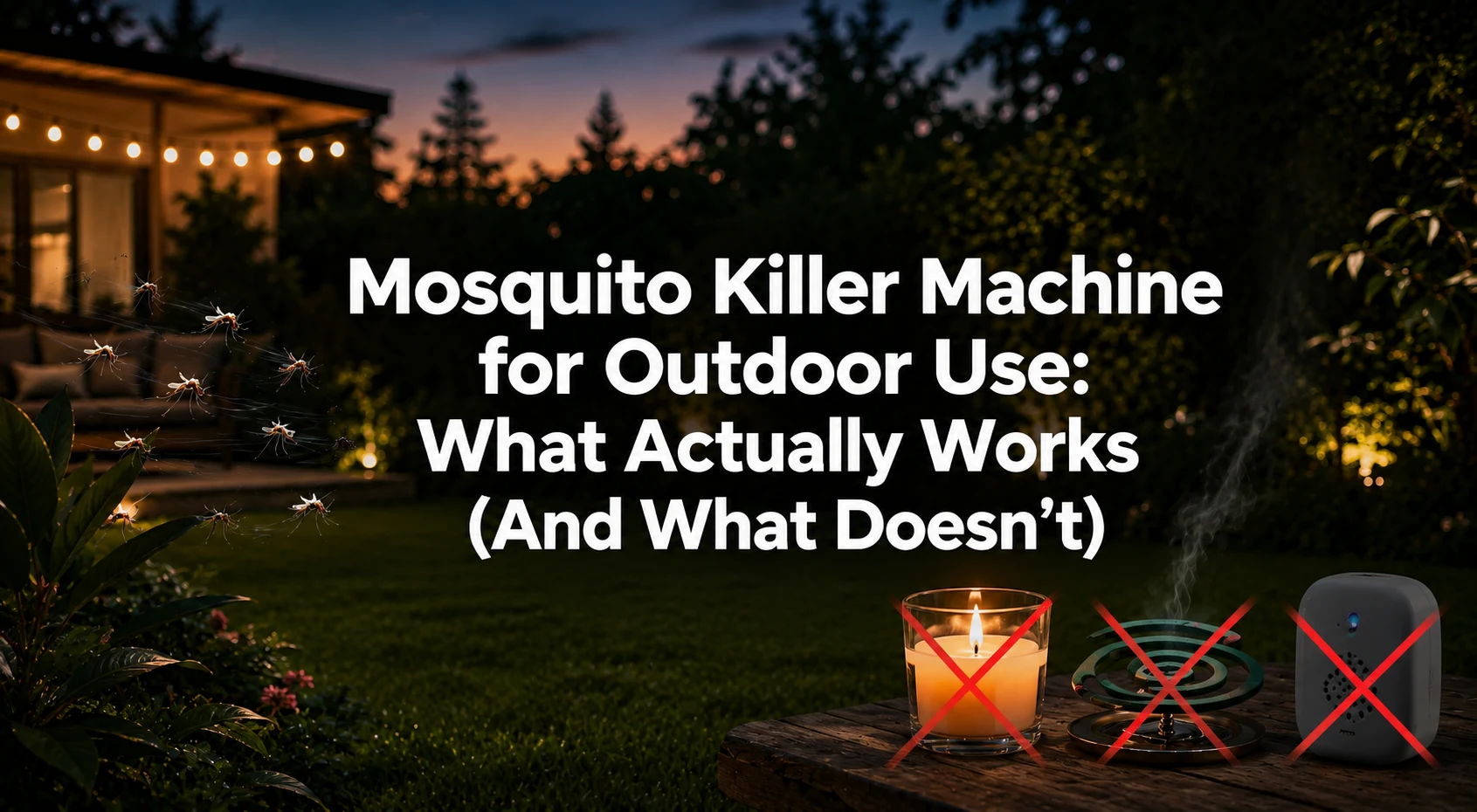
Machine vs. Spray vs. Coil vs. Candle — Which One Actually Holds Up Outdoors?
Let’s be real about this instead of pretending they’re all equally decent options.
Coils and sprays release chemicals that just don’t stick around outdoors — the moment there’s a breeze, their effectiveness drops fast, and using too many of them isn’t great for anyone breathing that air regularly.
Citronella candles smell nice, sure, but their protection radius is tiny. Step a few feet away from the candle and you’re basically unprotected.
Electric swatting bats only get mosquitoes you can physically see and react to in time, which isn’t exactly practical when you’re trying to relax with family.
A proper mosquito killer machine for outdoor spaces, on the other hand, just keeps running. You don’t have to reapply anything, relight anything, or chase mosquitoes around with a bat in your hand. It covers a wider area and does it continuously.
If you’re someone who spends a good chunk of your evenings outside — whether that’s on a terrace, in the garden, or hosting people over for dinner — this is genuinely one of those purchases that pays off pretty quickly.
What You Should Actually Check Before Buying One
Not every machine on the market is worth your money, so here’s what I’d personally look at first:
Coverage area. A small balcony and a full backyard need very different machine capacities, so don’t just go by price—check what square footage it’s rated for.
Built for outdoor conditions. Dust, humidity, and the occasional rain shouldn’t be a problem for the unit you pick. Some cheaper machines aren’t really made to handle that.
How loud is it? You don’t want something buzzing or whirring in the background while you’re trying to have a conversation or fall asleep outside on a warm night.
Safety around kids and pets. No exposed wiring, no harsh chemical components — this matters a lot more than people initially think about.
Ease of cleaning. At some point you’ll need to empty or clean the collection tray, and this shouldn’t feel like a chore every single time.
Power setup. Some run off a regular electrical socket; others use rechargeable batteries, which is handy if there’s no outlet nearby where you want to place it.
If you want to see what a well-thought-out option actually looks like, this mosquito killer machine for outdoor setup is worth a look — it’s built specifically with Indian outdoor conditions in mind, so it holds up well in gardens, terraces, and patios rather than just performing well indoors.
A Quick Note on Placement
Buying the right machine is only half the job — where you put it matters too.
Keep it away from other bright lights like your porch bulb, since mosquitoes will just gravitate toward whichever light is stronger. Position it closer to areas where mosquitoes are likely to be hanging around already — near plants, drains, or anywhere water tends to collect. Height matters as well; around 3 to 4 feet off the ground tends to work best, since that’s roughly where mosquitoes fly most often. And don’t place it right next to where you’re sitting — a few feet away is better, so it intercepts mosquitoes before they even reach you.
Is It Actually Safe to Run Every Day?
Yes, and this is honestly one of the main reasons people are switching over. Since there’s no smoke or chemical fogging involved, these machines can run for hours — even overnight — without it being a health concern for your family or your pets. That’s a pretty big deal if you’re trying to move away from constantly inhaling coil smoke or spray fumes every evening.
Final Thoughts
At the end of the day, mosquitoes shouldn’t be the reason you avoid your own backyard or terrace. Sprays and coils give you a bit of temporary relief at best, but a dedicated mosquito killer machine for outdoor spaces gives you something sprays never really could — consistent, low-effort, chemical-free protection that just keeps working in the background. Whether it’s a family dinner outside, kids playing till late evening, or just you trying to unwind after a long day, having the right setup means you’re not fighting mosquitoes the whole time.
Frequently Asked Questions
1. What exactly is a mosquito killer machine for outdoor use? It’s a device made specifically to attract and eliminate mosquitoes in open areas like gardens, terraces, or patios—usually through UV light, suction, or an electric grid, instead of relying on chemical sprays or smoke.
2. Do these machines actually work well in open spaces, or just indoors? They’re built for open spaces specifically. That’s really the whole point — unlike coils and sprays, they don’t lose their effectiveness the moment there’s wind or open air around them.
3. Is it safe to have one running near kids or pets? Generally yes. Most machines don’t have exposed live wiring and don’t release any chemicals into the air, which already makes them a lot safer than sprays or coil smoke.
4. How often does it need cleaning? It really depends on how much mosquito activity there is around your home, but checking and cleaning the tray once every week or two is usually a safe habit to get into.
5. Can I just leave it running every day? Yes, that’s actually how they’re meant to be used. There’s no health risk with continuous daily use, unlike chemical-based repellents which aren’t great for constant exposure.
6. Where’s the best spot to place it outdoors? A few feet away from where people usually sit, near mosquito-prone areas like plants or stagnant water, and roughly 3 to 4 feet above the ground.
7. Does it work during the day too, or only at night? It’ll run fine throughout the day, but most of the activity you’ll notice happens in the evening and at night, since that’s when mosquitoes are most active anyway.
8. Is it really worth switching from sprays and coils? If you spend any real amount of time outside, yes — the safety, convenience, and long-term cost usually make more sense than constantly buying and reapplying sprays or coils that barely last.
