 brandinginfotech
Mosquitoes don’t find you by accident. Every breath you take, every step you walk, every bead of sweat — all of it sends out a chemical trail a female mosquito can pick up from more than 50 meters away. A mosquito CO2 trap exists because of one simple fact of insect biology: mosquitoes hunt by following carbon dioxide back to wherever it’s coming from. This guide walks through the biology, the physics, and the engineering behind that process, so you understand not just that CO2 traps work, but why.
Why Mosquitoes Are Drawn to Carbon Dioxide
Only female mosquitoes bite — they need the protein from blood to develop eggs — and they rely on a layered set of senses to find a host. CO2 is the first signal in that chain, and by far the longest range.
How Mosquitoes Actually Detect CO2
Mosquitoes pick up carbon dioxide through a pair of sensory structures called maxillary palps, positioned right next to the proboscis. Inside them sit neurons packed with receptor proteins tuned to shifts in CO2 concentration. And these receptors are sensitive — we’re talking fluctuations of just a few parts per million above the normal atmospheric baseline of roughly 400 ppm.
Here’s the interesting part: it’s not a fixed CO2 level that triggers host-seeking behavior. It’s a change over time. When you exhale, CO2 doesn’t come out as one smooth continuous stream — it comes in pulses, drifting through the air in turbulent little eddies rather than a flat, even cloud. Mosquitoes are wired to notice that pulsing pattern specifically, because it’s what separates a living, breathing animal from the static CO2 already sitting in the background air.
From Detection to Flight
Once those maxillary palps register a rising CO2 gradient, something switches in the mosquito’s behavior. It stops flying randomly and shifts into what researchers call upwind surge flight — short zigzagging bursts against the wind, using the plume as a kind of breadcrumb trail back to its source.
This is really the whole point behind a well-built CO2 trap. It isn’t just “release gas mosquitoes like.” It’s mimicking the plume dynamics of an actual breathing host closely enough that the insect’s navigation system locks on and commits. We go deeper into these detection pathways on our Science Blog, if you want the fuller picture of mosquito sensory biology.
It’s Not Just CO2 — The Full Sensory Picture
CO2 gets a mosquito pointed in roughly the right direction, but that’s only step one. Traps that work well tend to layer in more than just gas.
At long range — anywhere from 10 to 50 meters out — CO2 plumes do the heavy lifting, pulling the mosquito into general activation mode. Closer in, somewhere between 1 and 10 meters, body heat and moisture take over; mosquitoes have thermoreceptors that pick up on the warmth radiating off a body, plus the humidity difference from breath and skin. And once they’re within a meter or so, it becomes a visual game — tracking movement and contrast, then fine-tuning the landing using skin chemicals like lactic acid, octenol, and ammonia.
A trap that only pumps out CO2, with no heat, no moisture, no secondary lure, will often pull mosquitoes into the general area and then lose them right before capture — because at that point, the insect is expecting warmth and doesn’t find any. That’s a big part of why the better traps stack multiple cues instead of relying on gas alone, something we cover in more detail on the CO2 Blog.
What’s Actually Happening Inside a CO2 Trap
Mechanically, a trap has four jobs: make CO2, release it in a way that mimics a real plume, pull responding mosquitoes into a capture zone, and then not let them escape.
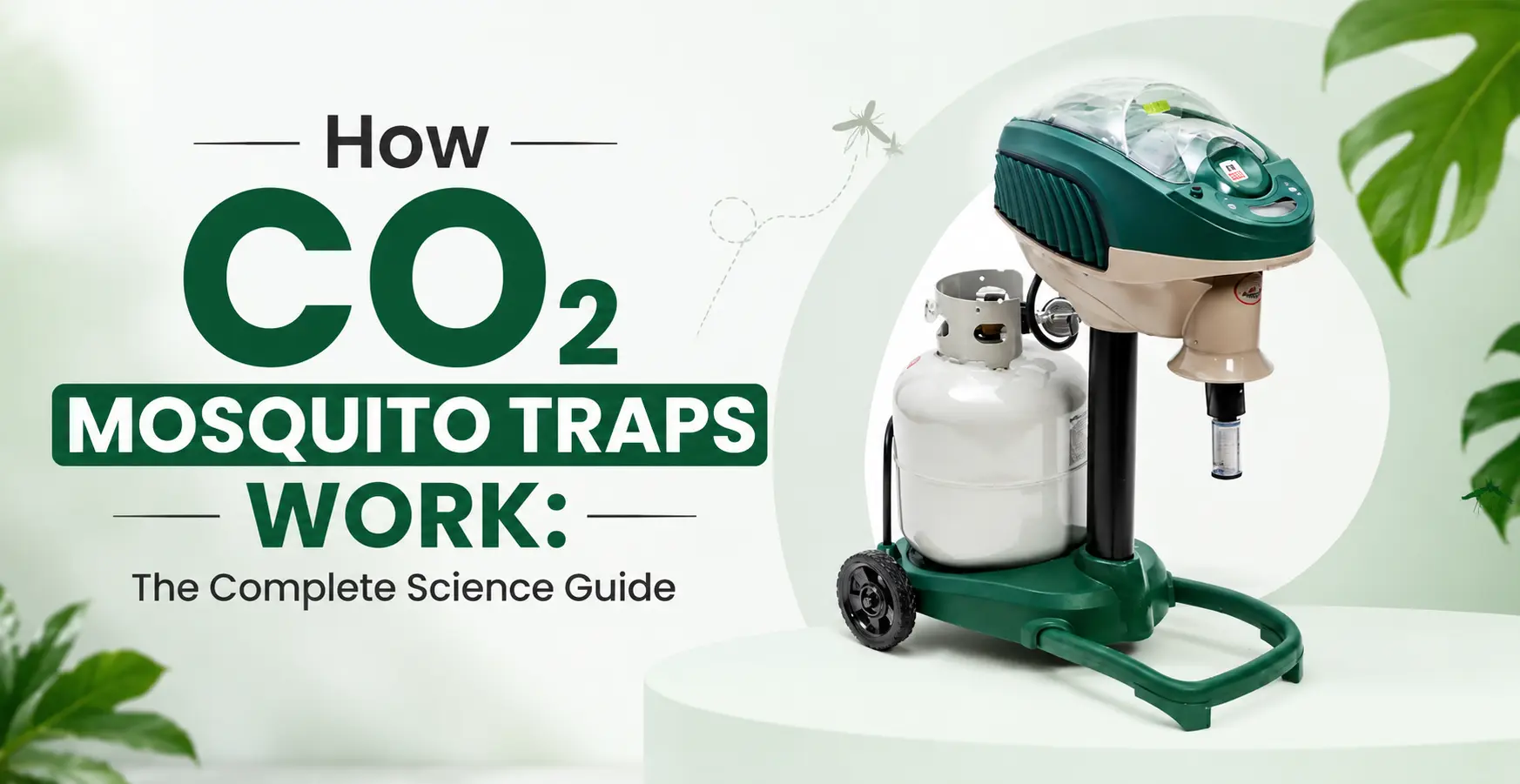
Generating the CO2. There are three common routes here. Propane combustion — burning propane with oxygen produces CO2 plus water vapor as a byproduct — is the most common in outdoor traps, mainly because it gives you a continuous, high-volume gas stream along with heat and moisture at the same time, which happens to closely resemble what a large mammal exhales. That combination of heat and CO2 together is a big reason propane-based units tend to outperform units running on CO2 alone. Fermentation-based traps, where sugar and yeast react to release CO2, are the low-cost DIY route — cheap to run, but the output is lower and less steady. And then there are compressed or liquid CO2 tanks with a regulator, which give you precise, metered control over the gas flow, though without the heat and moisture that combustion naturally throws in.
Getting the plume right. The gas doesn’t just get vented out flat. It’s released through a nozzle designed to pulse rather than flow in a steady stream, and to disperse with some natural turbulence instead of shooting straight out — because remember, mosquitoes are keyed into that pulsing signature. Wind direction and local airflow around the trap matter enormously at this stage.
Pulling mosquitoes in. As they follow the plume upwind, mosquitoes enter the trap’s capture zone, where a fan creates suction that draws them the rest of the way. A lot of traps add octenol, lactic acid compounds, or a UV/LED light source tuned to wavelengths insects can see, positioned right at the point of capture to hold their attention through that final close-range phase.
Actually catching them. Once past the intake, mosquitoes end up in a net, a sticky surface, or a dehydration chamber, where they can’t get back out and die within a set window. This last stage matters more than people give it credit for — a trap can attract mosquitoes beautifully and still underperform if the vacuum is weak or the capture net lets insects slip back out.
If you want a closer look at how these four stages get engineered in practice, that’s covered on our Prevention Technology page.
More CO2 Isn’t Always Better
A common assumption is that cranking up CO2 output automatically means catching more mosquitoes. In practice, research on host-seeking behavior shows diminishing returns pretty quickly, because mosquitoes are responding to a pattern, not raw volume. Two things matter more than sheer output:
Pulsing beats a constant stream — a steady, unchanging flow of CO2 is actually less attractive than one with natural variation, since it doesn’t match the breathing pattern mosquitoes are looking for. And layering in a second cue almost always beats CO2 by itself; field comparisons of CO2-only traps versus CO2-plus-heat or CO2-plus-octenol setups generally show noticeably higher capture rates once that second signal is added, because it fills in the close-range handoff a real host would provide.
This is exactly why the current generation of CO2 traps are built as multi-cue systems rather than single-gas emitters — they’re designed to carry the mosquito through its entire decision-making process, not just the first ten meters of it.
A Quick Comparison of Trap Types
| Trap Type | CO2 Source | Secondary Attractants | Best For | Maintenance |
|---|---|---|---|---|
| Propane combustion traps | Burned propane | Heat, moisture, often octenol | Large yards, heavy infestations | Propane refills, periodic cleaning |
| Compressed CO2 tank traps | Pressurized gas canister | Optional UV/lure add-ons | Steady, controllable output | Tank refills or exchange |
| Fermentation (DIY) traps | Sugar-yeast reaction | Rarely included | Low-budget, small-area use | Frequent solution changes |
| Hybrid electric traps | Catalytic/chemical CO2 generation | LED light, heat elements, lures | Residential and semi-commercial use | Cartridge swaps, cleaning |
Each of these makes different tradeoffs around cost, coverage, and consistency — but underneath all of them, the same science applies: mimic the plume, back it up with secondary cues.
Where You Put the Trap Matters More Than People Think
Even a genuinely well-built CO2 trap will disappoint if it’s placed badly, because plume behavior is so sensitive to its surroundings.
Distance from where people actually gather matters — traps generally work best 15 to 30 feet from patios or entryways, pulling mosquitoes toward the trap and away from you, rather than competing directly with the CO2 you’re already exhaling nearby. Placing it downwind of standing water or dense, shaded vegetation intercepts mosquitoes as they head toward your yard in the first place. Height matters too; a lot of common biting species fly and rest at particular altitude bands, so traps positioned around knee to waist height tend to do better than ones mounted very high or sitting flat on the ground. And it’s worth keeping the trap away from competing CO2 sources — an outdoor grill or a cluster of people nearby will dilute or outcompete the trap’s own plume.
Does It Actually Work? Measuring Real-World Effectiveness
Researchers usually measure this by comparing how many mosquitoes land on human volunteers with and without a trap running nearby, alongside direct counts from the trap itself over a set period. Well-designed CO2 traps consistently reduce nearby biting pressure in these studies — and the effect tends to compound over multi-week deployments, since traps suppress local population density rather than just redirecting a few mosquitoes on any single night.
Worth setting expectations correctly here: a CO2 trap is a population-control tool, not an instant-relief device. It works by intercepting host-seeking females over time, cutting down egg-laying and therefore future generations — so the payoff builds over weeks rather than clearing your yard overnight.
A Few Myths Worth Clearing Up
“More propane equals more mosquitoes caught.” Not really — past a certain point, mosquitoes are responding to plume shape and pulsing rather than raw gas volume. Overdriving the trap just burns fuel without much extra benefit.
“A CO2 trap will pull in mosquitoes from your neighbor’s yard and make things worse.” In practice, a well-placed trap intercepts mosquitoes already moving through the area on their normal host-seeking flights — it doesn’t meaningfully extend how far a mosquito would fly anyway, which for most species is within a few hundred meters of where they hatched.
“A trap means I don’t need to worry about standing water.” Traps catch adults, not larvae. Eliminating standing water is still essential — a trap works best alongside source reduction, not instead of it.
Environmental Factors That Change How Well a Trap Performs
Because everything here hinges on plume physics, the environment around the trap can matter as much as its internal design.
Wind is a big one. A light, steady breeze — somewhere around 3 to 8 km/h — tends to carry the plume furthest while keeping it coherent enough for mosquitoes to track. Dead-still air lets CO2 pool close to the trap, shrinking its effective range, while gusty, turbulent conditions can shred the plume apart before a mosquito can lock onto the gradient.
Temperature plays a role too, since mosquito activity itself drops off outside the roughly 20–30°C range that most species prefer, no matter how good the trap is. Humidity has a smaller but real effect on how the heat-and-moisture component of a propane trap’s plume disperses.
Physical clutter — fences, dense shrubs, walls — can block airflow entirely or create odd pockets where CO2 either never reaches or pools unexpectedly. Open ground with a clear upwind path generally gives more predictable results than a trap tucked into a corner, even if that corner happens to be where mosquitoes like to rest during the day.
And time of day isn’t a non-factor either. Species like Aedes and Culex have sharp activity peaks around dawn and dusk, so even a trap running around the clock will naturally show most of its catches during those windows.
Keeping a Trap Running Well Over Time
A CO2 trap is genuinely only as good as its upkeep. A few habits make a real difference over months of continuous outdoor use:
Clean the capture chamber regularly — trapped insects, debris, and moisture buildup can clog the intake or netting and quietly tank your capture rate. Keep an eye on propane levels, since a dwindling tank means a weaker, less realistic plume. Swap out lure cartridges like octenol on schedule (usually every 3 to 6 weeks), since they lose potency over time. Reassess placement as the seasons change — vegetation grows, wind patterns shift, seating areas move. And after any serious storm, it’s worth checking that the trap hasn’t been knocked out of position.
Treating a trap as something you set up once and forget is probably the single biggest reason people end up disappointed with the results. The science behind it is solid — it just needs to be kept in the condition it was designed to run in.
Frequently Asked Questions
How far away can a mosquito actually detect a CO2 trap? In good wind conditions, mosquitoes can pick up and orient toward a CO2 plume from roughly 30 to 50 meters out, though realistic capture range in a typical yard is usually closer to 10–20 meters once you factor in obstacles and competing scents.
Do these traps work on every mosquito species? Most host-seeking females respond to CO2 in some form, since it’s a near-universal cue for finding blood meals. That said, sensitivity varies by species, which is why traps combining CO2 with heat, moisture, and lures tend to hold up better across a mixed local mosquito population.
Propane or a compressed CO2 tank — which is better? Propane combustion traps generally win out, mainly because the combustion process also produces heat and moisture as a side effect, adding that mid-range thermal cue mosquitoes are looking for. Compressed tanks give steadier, more controllable flow, but need extra heat or lure sources to really match propane-trap performance.
How soon will I actually notice fewer mosquitoes? Most people see some drop in biting pressure within the first one to two weeks, with the bigger population-level effect usually building over four to six weeks as the trap keeps more females from completing an egg-laying cycle.
Can a CO2 trap be combined with other control methods? Yes, and it should be. CO2 traps work best paired with eliminating standing water, larvicide treatments where water can’t be removed, and barrier sprays on vegetation — the trap handles adult host-seeking mosquitoes while the rest disrupt the earlier stages of the life cycle.
The Short Version
Mosquitoes track CO2 through receptors tuned to pick up rising, pulsing concentration — not some fixed threshold. The traps that actually work well replicate the layered experience of a real host: CO2 to pull mosquitoes in from a distance, heat and moisture to confirm at mid-range, and lures or visual cues to close the deal. Propane-based traps tend to outperform pure CO2 sources simply because they’re replicating more than one cue at once. And where you place the trap — distance, height, wind exposure — ends up mattering just as much as how much CO2 it puts out.
None of this works in isolation, though. Understanding the biology is really just the starting point; placement, upkeep, and pairing the trap with broader prevention steps are what turn the science into results you actually notice in your yard.
